Leave Your Message
-
E-mail
-
Skype
-
Whatsapp
-
Wechat

Choosing a Street Light Control System is no longer a simple equipment decision. It affects energy use, maintenance, safety, and public trust.
The International Energy Agency reports that lighting represents about 15% of global electricity consumption. Its Energy Efficiency 2023 analysis also highlights connected controls as an important efficiency opportunity. The U.S. Department of Energy has repeatedly documented that LED lighting delivers major energy savings, especially when paired with dimming and scheduling. Yet replacing lamps alone is not enough. A poorly configured system can leave streets overlit at midnight and under-responsive during heavy rain.
Harry Verhaar, a long-time lighting-policy expert and former Signify sustainability leader, said, “Lighting is not just about seeing; it is about enabling people to live, work, and thrive.” That principle changes the buying conversation. Look for adaptive dimming, fault alerts, open communication protocols, cybersecurity safeguards, and accurate energy reporting. Check the dashboard, not only the brochure. Ask how the system behaves when connectivity fails.
Reports from MarketsandMarkets and Grand View Research forecast strong growth in smart street lighting. Their estimates differ because market definitions vary. That matters. A claimed 30% saving may describe a pilot, not a whole city.
The right system should fit local roads, weather, budgets, and maintenance skills. It should also produce evidence after installation. A useful trial might compare power demand on identical roads, inspect outage response times, and collect resident feedback. Some assumptions will be wrong. That is acceptable, if the procurement process leaves room to measure, learn, and improve.
How to Choose a Street Light Control System?
Understanding Street Light Control System Basics starts with the control layer, not the lamp. A basic system uses photocells or astronomical clocks to switch lights at the right time. A more advanced system adds dimming, remote monitoring, fault alerts, and energy reports. The U.S. Department of Energy reports that LED lighting can use at least 75% less energy and last up to 25 times longer than incandescent lighting. However, efficient lamps still waste energy when controls are poorly scheduled. That detail is easy to miss.
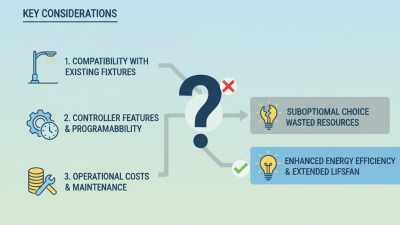
Choose a system that matches road conditions, maintenance skills, and communication coverage. Dimming profiles should reflect traffic patterns, pedestrian activity, and safety requirements. Wireless control can simplify installation, but signal gaps may appear near tunnels, trees, or dense buildings. A local fallback schedule is essential. Nothing is perfect. Pilot testing usually reveals problems that specifications hide. The European Commission has noted that public lighting can represent a significant share of municipal electricity use, sometimes reaching 40%. Accurate measurement matters before and after installation.
Tips: Check controller compatibility, operating temperature, surge protection, and manual override options. Request open data access and clear cybersecurity procedures. Compare measured kilowatt-hour savings, not only promised percentages. Keep a simple paper record too; software dashboards can fail. Review dimming levels after several weeks, because the first setting may be too bright or too aggressive.
| Evaluation Dimension | Key Requirement | Common Options and Typical Characteristics | Selection Guidance |
|---|---|---|---|
| Control Architecture | How lighting commands are distributed |
Stand-alone control Local photocell, timer, or astronomical clock controls each luminaire independently. Centralized control A cabinet or control center manages a group of lights. Networked control A gateway and field controllers enable individual or group control. |
Choose stand-alone control for simple roads and small projects. Use centralized or networked control when remote monitoring, scheduling, fault reporting, or detailed energy data is required. |
| Communication Method | How data travels between the controller, gateway, and luminaires | Wired power-line communication uses existing electrical conductors. Wireless RF or mesh networks use short-range radio links. Cellular communication uses public mobile networks. Some systems combine more than one method. | Consider road layout, cabinet locations, underground infrastructure, radio interference, cellular coverage, installation cost, and the need for independent luminaire control. |
| Control Precision | Required level of switching and dimming | Basic systems provide on/off switching. Advanced systems support scheduled dimming, astronomical-clock operation, calendar adjustments, group scenes, and individual luminaire commands. | For residential streets, fixed dimming schedules may be sufficient. For roads with changing traffic or safety requirements, select a system that supports multiple dimming levels and flexible schedules. |
| Energy-Saving Functions | Ability to reduce unnecessary operating power | Typical functions include dusk-to-dawn operation, midnight dimming, programmable schedules, daylight compensation, occupancy or traffic-based control, and power-consumption measurement. | Energy savings depend on the original operating schedule, luminaire efficiency, dimming level, traffic pattern, and maintenance condition. Request a site-specific energy model instead of relying on a universal percentage. |
| Monitoring and Fault Detection | Visibility of system status and failures | Basic controls may only indicate whether a circuit is energized. Networked systems can report lamp failure, controller offline status, abnormal voltage, over-temperature conditions, communication loss, and energy readings when supported by the hardware. | For large or safety-critical networks, prioritize real-time alarms, historical data, map-based dashboards, and clear fault-location information. |
| Scalability | Ability to expand the system later | Stand-alone controls scale by adding independent devices. Centralized systems usually expand by adding circuits or cabinets. Networked systems can scale by adding controllers, gateways, communication subscriptions, or management licenses. | Estimate the number of luminaires, control cabinets, communication zones, users, and future roads before selecting the platform. Confirm the maximum supported device count and network capacity. |
| Installation Requirements | Changes needed to existing infrastructure | A photocell or timer generally requires limited field work. Cabinet-based systems may require electrical modifications. Networked controls may require luminaire controllers, gateways, antennas, configuration, commissioning, and communication testing. | Check luminaire compatibility, control interfaces, cabinet space, circuit loading, protective devices, pole access, and local electrical regulations before installation. |
| Interoperability | Compatibility with luminaires and management software | Common lighting control interfaces include line-voltage switching, 0–10 V dimming, DALI-based control, and standardized outdoor luminaire receptacles. Compatibility depends on the exact controller, driver, wiring, and software configuration. | Verify electrical ratings, dimming range, connector type, addressing method, firmware support, and available application programming interfaces before purchasing equipment. |
| Reliability and Fail-Safe Operation | Behavior during faults or communication loss | Systems may use local schedules, backup clocks, default dimming levels, automatic bypass, surge protection, and stored operating profiles to keep lights functioning when communication is interrupted. | Define the required fallback state in advance. For essential roads, the system should continue safe local operation during gateway, network, software, or power-communication failures. |
| Cybersecurity and Access Control | Protection of connected lighting assets | Important measures include unique user accounts, role-based permissions, encrypted communications, secure firmware updates, audit logs, network segmentation, and controlled remote access. | Ask for documented security practices, update procedures, data ownership terms, password policies, and incident-response responsibilities, especially for internet-connected systems. |
| Maintenance and Lifecycle | Long-term serviceability and total cost | Lifecycle costs include controllers, gateways, installation, commissioning, software or communication fees, replacement parts, maintenance labor, training, and eventual hardware renewal. | Compare total cost of ownership over the expected service period rather than comparing equipment price alone. Confirm spare-part availability and support arrangements. |
| Best-Fit Application | Typical project environment | Stand-alone controls suit small roads and basic schedules. Cabinet-based control suits grouped circuits with limited monitoring. Networked control suits large municipalities, smart-city projects, high-maintenance areas, and applications requiring detailed operational data. | Choose the least complex system that meets safety, control, reporting, expansion, and maintenance requirements. Avoid adding connectivity that the operating team cannot support. |
Note: Actual performance depends on the luminaire driver, wiring, communication environment, local regulations, operating schedule, and commissioning quality. Confirm technical compatibility through a site survey and a pre-installation test.